

A 20-gallon saltwater aquarium is one of the best entry-level marine tank sizes. It is small enough to fit in most rooms, but large enough to give beginners more stability than a tiny pico or 10-gallon nano tank.
Direct answer: The best saltwater fish for a 20-gallon tank are small, peaceful, site-attached fish that do not need long swimming lanes. Good choices include ocellaris clownfish, percula clownfish, firefish gobies, purple firefish, clown gobies, neon gobies, tailspot blennies, royal grammas, Banggai cardinalfish, and shrimp gobies such as Yasha gobies or yellow watchman gobies. Most 20-gallon saltwater tanks should hold about 3 to 5 small fish total, depending on adult size, aggression, filtration, aquascape, and maintenance routine.
Why is the stocking limit 3–5 fish? This guideline is based on the balance between the tank’s biological filtration, available territory, and the need to avoid overcrowding and aggression. In a 20-gallon tank, each fish adds to the bioload (waste production), which your filtration and live rock must process. Too many fish can overwhelm the filter, leading to ammonia or nitrate spikes. The aquascape also matters: more caves and hiding spots allow for more territories, but too many fish competing for limited space can trigger aggression and stress. Maintenance frequency is another factor—tanks with frequent water changes and careful monitoring may support the higher end of the range, while less frequent maintenance means you should stock more conservatively. The “3–5 fish” rule is a starting point, not a hard limit. Particularly small or sedentary species may allow for a slightly higher count, while more active or territorial fish may require fewer tankmates. Signs that your tank is at capacity include increased aggression, visible stress, hiding, refusal to eat, or declining water quality. Always observe your fish and be prepared to adjust stocking if problems arise.
For most hobbyists, a 20-gallon long aquarium is better than a 20-gallon high because it gives fish more horizontal swimming room and provides more usable territory across the rockwork.
Quick Stocking Rules for a 20-Gallon Saltwater Tank
- Best total fish count: Usually 3 to 5 small fish, depending on species, adult size, and tank setup.
- Best adult fish size: Ideally under 4 inches, with many choices closer to 2 to 3 inches.
- Best behavior type: Perchers, hiders, hoverers, and fish that stay near a territory.
- Fish to avoid: Tangs, large angelfish, butterflyfish, anthias, triggerfish, puffers, eels, foxfaces, and large aggressive clownfish species.
- Required equipment: Tight-fitting lid, heater, biological filtration, flow, and stable salinity.
Standard 20-Gallon Aquarium Dimensions
Most 20-gallon aquariums come in two common footprints: 20-gallon long and 20-gallon high. They hold the same approximate volume, but they behave differently as saltwater tanks.
| Tank Type | Length | Depth/Width | Height | Best Use |
|---|---|---|---|---|
| 20-Gallon Long | 30 in. / 76.2 cm | 12 in. / 30.5 cm | 12 in. / 30.5 cm | Best overall choice for fish, rockwork, and territory |
| 20-Gallon High | 24 in. / 61 cm | 12 in. / 30.5 cm | 16 in. / 40.6 cm | Useful when vertical space matters more than swimming room |

The extra 6 inches of length in a 20-gallon long tank matters. It gives fish more room to move, makes it easier to create separate territories, and gives you more flexibility when placing live rock.
If you need a smaller tank, compare these guides:
If you want more stocking flexibility, a larger tank will give you many more options:
- 30-Gallon Saltwater Tank Stocking Options
- 40-Gallon Breeder: Best Fish Options
- 50-Gallon Aquarium Selection Guide
- 55-Gallon Tank Dimensions and Stocking Guide
- 75-Gallon Stocking Blueprint
- 90-Gallon Aquarium Marine Fish
What Makes a Fish Good for a 20-Gallon Saltwater Tank?
The best 20-gallon saltwater fish are not simply the smallest fish. They are fish whose behavior fits the space.
- Small adult size: Most good choices stay under 4 inches.
- Low to moderate activity level: They do not spend the entire day pacing across open water.
- Territory-based behavior: They perch, hover, guard a cave, or stay near a section of rockwork.
- Peaceful temperament: They can coexist with other small fish without dominating the whole tank.
- Reliable feeding response: They accept normal aquarium foods and do not depend entirely on live microfauna.
High-activity fish, such as tangs or active wrasses, become stressed and unhealthy in limited space because they cannot swim the long distances they need for natural behavior. This stress can lead to pacing, loss of color, weakened immune systems, and increased disease risk. Territorial or aggressive fish, when confined in a small tank, may dominate or injure tankmates—sometimes preventing others from feeding or occupying any territory at all. For example, a single aggressive clownfish or dottyback can claim the entire tank, leaving other fish to hide constantly or starve. In contrast, site-attached or sedentary fish (like gobies, blennies, or firefish) tend to stay near their chosen spot, reducing conflict and stress. This makes them much better suited for small aquariums, where space and territories are limited. Choosing fish with compatible behaviors is key to a peaceful, healthy nano tank.
Saltwater Fish to Avoid in a 20-Gallon Tank
A 20-gallon aquarium can be a successful marine tank, but it is still a small system. The biggest stocking mistakes usually come from choosing fish that are too active, too large, too aggressive, or too specialized.
Avoid Large Open-Water Swimmers
Active fish that cruise long distances need more room than a 20-gallon tank can provide. Avoid tangs, large angelfish, butterflyfish, anthias, foxfaces, and most active reef wrasses.
These fish may look small when sold as juveniles, but their adult size and swimming behavior make them poor choices for a 24- to 30-inch aquarium. Juvenile size is not a reliable indicator of long-term suitability: large species kept in undersized tanks often suffer from stunted growth, chronic stress, and increased susceptibility to disease. Even if you plan to “upgrade later,” the fish may not thrive in the meantime. Responsible stocking means planning for adult size and behavior from the start.
Avoid Large or Aggressive Fish
Heavy-bodied predators and territorial fish can quickly overwhelm a 20-gallon tank. Avoid triggerfish, puffers, marine eels, lionfish, large dottybacks, and aggressive clownfish species such as maroon clownfish, tomato clownfish, and Clarkii clownfish.
These fish either produce too much waste, need larger territories, or become aggressive enough to limit your other stocking options.
Be Careful With Specialized Feeders
Mandarinfish and scooter dragonets are often discussed in nano tank stocking lists, but they require caution. Wild-caught dragonets usually depend heavily on live copepods and can starve in small, immature aquariums.
A captive-bred mandarin or captive-bred scooter dragonet that is already eating prepared foods may be possible in a mature 20-gallon tank, but this is not the safest beginner choice. Only consider one if the tank is stable, the fish is demonstrably eating frozen or prepared foods before purchase, and you are prepared to target-feed and monitor body condition closely.
Best Saltwater Fish for a 20-Gallon Tank
The following fish groups are the strongest candidates for a 20-gallon saltwater aquarium. You should not add one fish from every category. Instead, use the table to build a balanced stocking plan with compatible roles.
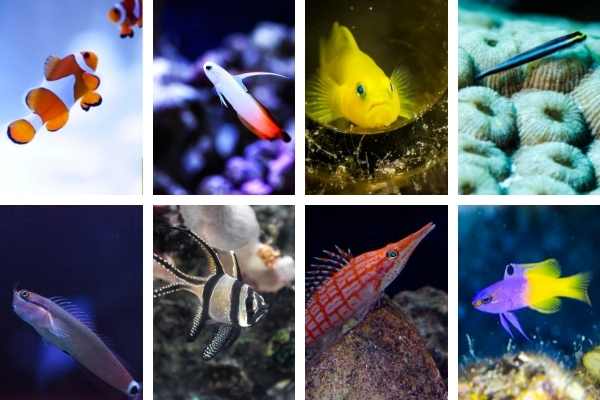
| Fish Group | Good Options | Stocking Limit | Notes |
|---|---|---|---|
| Clownfish | Ocellaris clownfish, percula clownfish, orange skunk clownfish, pink skunk clownfish | 1 pair max | Choose smaller, more peaceful clownfish species. Avoid maroon, tomato, and Clarkii clownfish in a 20-gallon tank. |
| Dartfish | Firefish goby, purple firefish, zebra dartfish, scissortail dartfish | 1 max | Peaceful and attractive, but prone to jumping. A tight lid is mandatory. |
| Small Gobies | Clown goby, Yasha goby, two-spot goby, court jester goby | 1 max from this group in most tanks | Excellent nano fish. Some species do best in mature tanks with stable feeding opportunities. |
| Cleaner Gobies | Neon goby, yellowline goby, sharknose goby, hybrid cleaner goby | 1 max in most mixed nano tanks | Small, peaceful, and useful community fish. A strong choice for beginners. |
| Small Blennies | Tailspot blenny, two-spot blenny | 1 max | Fun personality and useful grazing behavior. Do not mix multiple similar blennies in this size tank. |
| Cardinalfish | Banggai cardinalfish, yellow cardinalfish, longfin cardinalfish | 1 max, or a compatible pair with caution | Slow, hovering swimmers that fit nano tanks better than active open-water fish. |
| Fairy Basslets | Royal gramma, blackcap basslet | 1 max | Colorful cave-oriented fish. Give them rockwork and do not combine with overly timid tankmates in a cramped aquascape. |
| Small Hawkfish | Flame hawkfish, longnose hawkfish, Falco hawkfish | 1 max | Best for more assertive tanks. May eat very small shrimp and can intimidate timid fish. |
- Avoid mixing multiple territorial species from the same group (e.g., two blennies or two basslets) to reduce competition for similar niches.
- Introduce the least aggressive fish first, allowing them to establish territories before adding more assertive species.
- Add the most territorial or dominant fish last to minimize bullying of new arrivals.
- Observe fish behavior during acclimation and be prepared to rehome individuals if aggression or stress becomes a problem.
- Plan your stocking with both compatibility and territory in mind for long-term stability.
Sample 20-Gallon Saltwater Tank Stocking Plans
These sample stocking plans are more useful than a generic list because they show how the fish fit together by behavior and territory.
Beginner Community Plan
- 1 pair of ocellaris clownfish
- 1 firefish goby
- 1 tailspot blenny
- Optional: 1 neon goby if filtration and maintenance are strong
This is a strong beginner plan because the fish use the tank differently. The clownfish occupy the open center or a chosen corner, the firefish hovers near a cave, and the tailspot blenny perches and grazes around the rockwork.
Peaceful Goby-Focused Plan
- 1 clown goby
- 1 neon goby
- 1 Yasha goby with a pistol shrimp
- 1 small cardinalfish
This plan creates a quieter tank with more subtle behavior. It is a good fit for hobbyists who enjoy watching small interactions rather than constant movement.
Clownfish-Free Nano Reef Plan
- 1 royal gramma
- 1 tailspot blenny
- 1 firefish or purple firefish
- 1 cleaner goby
This option gives you color, movement, and personality without making clownfish the center of the tank.
More Assertive 20-Gallon Plan
- 1 royal gramma or blackcap basslet
- 1 Falco hawkfish or flame hawkfish
- 1 tailspot blenny
- Optional: 1 clownfish or cardinalfish, depending on temperament
This is not the best first stocking plan, but it can work for hobbyists who want bolder fish. Add the most territorial fish last and avoid very timid tankmates.
Can You Keep Damselfish in a 20-Gallon Tank?
Damselfish can live in a 20-gallon saltwater tank, but they are not the easiest community fish. Many damsels are colorful, hardy, inexpensive, and aggressive. The aggression is the problem.
If you want a peaceful mixed reef, avoid most damselfish. If you want a damsel-focused tank, choose carefully and do not mix them with timid gobies or firefish.
Better Damselfish Choices
- Yellowtail damselfish
- Azure damselfish
- Springer’s damselfish
Damselfish to Avoid or Treat With Caution
- Blue devil damselfish
- Domino damselfish
- Three-stripe damselfish
- Four-stripe damselfish
- Blue velvet damselfish
A damsel-only 20-gallon tank is possible, but it should be stocked lightly and designed with broken sightlines, caves, and multiple territories. For most beginners, peaceful gobies, clownfish, blennies, and cardinalfish are better choices.
Best Invertebrate Pairings for a 20-Gallon Tank
A 20-gallon tank becomes much more interesting when you use invertebrates to add behavior without overloading the fish stocking limit.
Shrimp Goby and Pistol Shrimp Pair
A Yasha goby or yellow watchman goby can form a fascinating partnership with a pistol shrimp. The shrimp maintains the burrow while the goby watches for danger. This is one of the best behavior-based stocking ideas for a small saltwater tank.
Give the pair a sandy bottom and stable rockwork that will not collapse if the shrimp digs beneath it.
Cleaner Shrimp
A cleaner shrimp can be a good addition to a peaceful 20-gallon tank. It adds movement, helps pick at leftover food, and often becomes one of the most visible animals in the aquarium.
Do not combine tiny ornamental shrimp with hawkfish, larger predatory fish, or aggressive tankmates that may eat them.
Sexy Shrimp and Rock Flower Anemones
Sexy shrimp are small, active invertebrates that can be kept around rock flower anemones. Rock flower anemones are often a better fit for nano tanks than bubble-tip anemones because they are less likely to roam around the aquarium.
They can still sting nearby corals, so leave space around them and avoid placing them where they will touch sensitive coral tissue.
Macroalgae Display Tanks for 20-Gallon Aquariums
A 20-gallon tank can also work well as a macroalgae display. Instead of building the tank entirely around coral, you can use decorative marine macroalgae to create movement, color, and habitat structure.
Common macroalgae options include Dragon’s Breath, Caulerpa, and Blue Hypnea. Macroalgae can help absorb nitrate and phosphate, but it is not a replacement for water changes, nutrient testing, or regular pruning. Unchecked macroalgae growth can cause problems: If not pruned regularly, fast-growing macroalgae can outcompete corals for light and nutrients, or die off suddenly, causing nutrient spikes. At night, dense macroalgae beds may reduce oxygen levels in the tank. Monitor macroalgae health, prune as needed, and remove decaying material promptly to avoid destabilizing your aquarium.
Good fish choices for a macroalgae-focused 20-gallon tank include:
- Tailspot blenny
- Clown goby
- Firefish goby
- Neon goby
- Small cardinalfish
Use caution with fast-growing macroalgae. Some varieties can spread aggressively and may need frequent trimming.
Essential Equipment for a 20-Gallon Saltwater Tank
Good equipment does not need to be complicated, but a 20-gallon saltwater tank does need stability. Small tanks change quickly, so consistency matters.
Tight-Fitting Lid
A lid is not optional for many of the best nano saltwater fish. Firefish, dartfish, gobies, wrasses, and other startled fish can jump through surprisingly small openings. Without a tight lid, jumpers are likely to escape—even a small gap can result in lost fish. Check the lid regularly for gaps or warping.
Heater
Use a reliable aquarium heater sized appropriately for a 20-gallon tank. Many hobbyists use a heater in the 75- to 100-watt range, depending on room temperature and equipment setup. Heater failure can cause rapid temperature swings, which stress or kill fish and invertebrates. Use a thermometer to monitor temperature daily, and consider a backup heater or temperature alarm for added safety.
Filtration
Biological filtration is the foundation of the system. Live rock, a hang-on-back filter, an all-in-one rear chamber, or another suitable filter can work if the tank is stocked conservatively and maintained consistently. If filtration is inadequate or fails, ammonia and nitrite can quickly rise to dangerous levels. Monitor water parameters regularly, and clean or replace filter media as recommended.
Do not rely on equipment as an excuse to overstock. A 20-gallon tank still has limited swimming room, limited territory, and limited dilution capacity.
Water Flow and Surface Agitation
Use a small powerhead, return pump, or other flow source to keep water moving and to agitate the surface. Surface movement improves gas exchange and helps prevent stagnant areas behind the rockwork. Insufficient flow leads to dead spots, poor oxygenation, and can promote algae or cyanobacteria growth. Watch for areas of detritus buildup and adjust flow as needed.
Lighting
Fish-only tanks do not require expensive reef lighting. If you plan to keep corals, choose lighting appropriate for the types of corals you want, and avoid adding high-light corals before the tank is stable.
Testing and Maintenance Supplies
At minimum, you should be able to monitor salinity, temperature, ammonia during setup, nitrate, and basic reef parameters if you keep corals. A consistent water-change routine is especially important in a small aquarium.
Beginner Mistakes to Avoid
- Adding too many fish: Overloads the biological filter, leading to ammonia spikes, declining water quality, and potential fish loss.
- Buying juvenile fish without checking adult size: Many fish are sold small but do not stay small. Keeping large species in a small tank causes stunted growth, chronic stress, and increased disease risk.
- Skipping the lid: Many good nano fish are jumpers. Without a tight lid, fish can escape and die.
- Mixing timid and aggressive fish: Firefish, gobies, and small peaceful fish do poorly with bullies. Timid fish may hide, refuse to eat, and eventually die from stress.
- Adding fish too quickly: The biological filter needs time to adjust between additions. Stocking too fast can overwhelm the system and cause ammonia spikes.
- Choosing fish for color only: Behavior, adult size, and feeding needs matter more than appearance. Ignoring these factors can lead to aggression, incompatibility, or starvation.
Helpful Saltwater Aquarium Setup Guides
Once you have a stocking plan, use these guides to build the system correctly:
- How to Mix Fresh Saltwater at Home
- Step-by-Step Saltwater Aquarium Setup Guide
- How Much Live Rock Do You Actually Need?
- Top 5 Best Soft Corals for Beginners
- Comprehensive Cleaner Shrimp Care Guide
Final Recommendation
For most beginners, the safest 20-gallon saltwater stocking plan is a peaceful community built around a pair of ocellaris or percula clownfish, one small goby or dartfish, and one small blenny or cleaner goby. Keep the total fish count modest, add fish slowly, use a tight lid, and avoid species that need more swimming room or larger territories.
A 20-gallon saltwater aquarium is not large, but with the right fish choices, it can be stable, colorful, and full of interesting behavior.