
There is just something about coral reefs that has captivated me since I was a child. The corals, clams, shrimp, crabs, and shrimp fighting for survival and yet somehow seeming to thrive as a community, buzzing with energy and popping in color.
I think many of us strive to recreate that with our reef tanks. If you’re looking to bring a piece of the ocean home, here is a list of the 15 Most Colorful Saltwater Fish for an Aquarium.
1. Regal Blue Tang
There is a reason the Pixar team picked the Regal Blue Tang as the species to represent the lovable and unforgettable Dory. The vivid blue coloration, accented by black markings and a splash of yellow on the tail, makes this fish instantly recognizable and a showstopper in any aquarium.

What to Watch For: Regal Blue Tangs require a large tank (at least 100 gallons) due to their active swimming and eventual adult size. They can be prone to ich and other diseases, especially when stressed. Territorial with other tangs, they may show aggression in smaller tanks. Provide plenty of swimming space and hiding spots.
2. Pajama Cardinalfish
This reef fish is the OG at mastering the working from home in its pajamas look. The combination of pink polka-dots, black stripes, yellow, red, and black colors leaves you wondering what look they were going for exactly. Are they camouflaged for a rave or perhaps they just confuse would-be predators by making them laugh?

What to Watch For: Pajama Cardinalfish are peaceful, hardy, and do well in groups. They are suitable for beginners and small tanks (30+ gallons). They are nocturnal and may be shy at first. Ensure peaceful tankmates and provide hiding places.
3. Ocellaris Clownfish
The fish that started it all, the orange, black, and white Ocellaris clownfish is the most popular reef fish for a reason. Their bold coloration and endearing behavior make them a staple in marine aquariums.

What to Watch For: Ocellaris Clownfish are hardy, peaceful, and adapt well to captivity. They can be kept singly or in pairs and are generally reef safe. Minimum tank size is 20 gallons. They may become territorial, especially when hosting anemones.
4. Purple Firefish
The name alone doesn’t do this gorgeous fish justice. The Purple Firefish is a dartfish with purple, white, pink, red, yellow, and green. Its iridescent coloration and elegant shape make it a standout among small reef fish.

What to Watch For: Firefish are notorious jumpers—secure lids are a must. They are peaceful but can be bullied by more aggressive tankmates. Minimum tank size is 20 gallons. Provide plenty of hiding spots to reduce stress.
5. Flame Angelfish
The fiery red Flame Angelfish blends some of the most vibrant red, orange, and purple you will see on any saltwater fish in an aquarium. Their compact size and striking colors make them a favorite among aquarists.

What to Watch For: Flame Angelfish require at least a 55-gallon tank. They may nip at corals and clams, so monitor closely in reef tanks. Can be territorial with other dwarf angels. Provide plenty of live rock for grazing and hiding.
6. Mandarinfish
Psychedelic is how you could describe the blue, green, and orange swirls of the Mandarin fish. These docile creatures are amazing to see, not just for their coloration, but also for their fluttery swimming and inquisitive eyes.

What to Watch For: Mandarinfish require a mature tank (at least 6 months old, 30+ gallons) with a thriving copepod population, as most will only eat live foods. They are peaceful but can starve in tanks without sufficient natural food. Avoid keeping with aggressive feeders.
The Mandarin dragonet is stunningly gorgeous, but also notoriously challenging to keep alive in a home aquarium. Knowing which fish to buy and which to avoid is key to having success in this hobby.
7. Lyretail Anthias
Red, orange, yellow, purple, and pink—the Lyretail Anthias combines the breathtaking colors from the most beautiful sunrises and sunsets and packs them into an amazing fish with fancy fins too.

What to Watch For: Anthias do best in groups and require frequent feedings of small, meaty foods. Minimum tank size is 70 gallons. They are peaceful but can be stressed by aggressive tankmates. Prone to jumping—use a secure lid.
8. Longnose Hawkfish
I hesitated about including the Longnose Hawkfish in this list of the most colorful saltwater fish for an aquarium—mostly because their two main colors are white and red—but the unique and amazing patterns of red and white are what made me ultimately determine to include them in this list.

What to Watch For: Longnose Hawkfish are hardy and adapt well to captivity. They may eat small shrimp or ornamental crustaceans. Minimum tank size is 30 gallons. Provide branching corals or rockwork for perching.
9. Bluespot Jawfish
Here’s a quick riddle (Dad Joke) for you—when does the Bluespotted Jawfish change its spots? Answer: When it moves from one spot in the tank to another.
At first glance, the yellow/green body might seem a bit drab, but they make up for it with blue spots that are so bright and shiny that they look like they run on batteries.
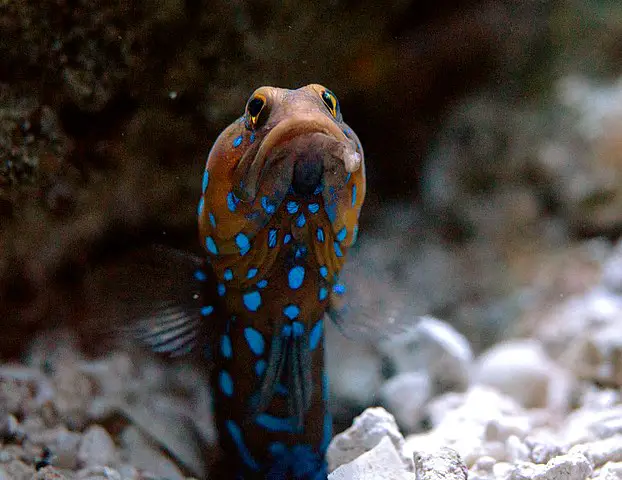
What to Watch For: Bluespot Jawfish are notorious jumpers and require a tight-fitting lid. They need a deep sand bed for burrowing and are best kept singly or in pairs. Sensitive to temperature swings—keep stable conditions.
10. Purple Tang
Looking for a fish with deep purple and yellow colors? At first glance, the Purple Tang is a stunner—and then when you look closer, you realize how intricate the coloration and patterns really are, with subtle spots and lines, almost like dark tattoos laid within the dark purple.

What to Watch For: Purple Tangs require a large tank (at least 100 gallons) and plenty of swimming space. They can be aggressive, especially toward other tangs. Provide ample algae and seaweed in their diet.
11. Yellow Tang
A Yellow tang adds a serving and a half of bright, canary yellow and perpetual motion to any saltwater aquarium. They are extremely popular, and unfortunately harder to acquire these days, due to restrictions on importing from Hawaii. But the good news is that they are one of the first, if not THE first of the tangs to be raised in captivity and available from Aquaculture facilities.

What to Watch For: Yellow Tangs need at least a 75-gallon tank. They are generally peaceful but may be territorial with other tangs. Herbivorous—provide plenty of algae. Can be prone to HLLE (head and lateral line erosion) if water quality is poor.
12. Clown Triggerfish
If you want to see one of the most gorgeous displays of abstract art using black, white, and yellow in interesting patterns, take a look at the Clown Triggerfish. Look carefully and you will even see some pink tones on fins.

What to Watch For: Clown Triggerfish grow large (up to 20 inches) and require a tank of at least 180 gallons. They are aggressive and not reef safe—may eat invertebrates and smaller fish. Best kept singly or with other large, robust fish.
13. Melanurus Wrasse
Get ready for this next fish, so that your head doesn’t explode when you see it. Sometimes the Melanurus Wrasse looks orange and green, sometimes it’s clearly pink and green, while other times it’s red and green. That’s a challenging trick to accomplish without actually changing color, but describes how this beautifully colorful and popular saltwater fish made the list.
 Also known as Hoeven’s wrasse, this reef fish is very colorful
What to Watch For: Melanurus Wrasses are active and excellent at pest control, but are notorious jumpers—cover your tank well. Minimum tank size is 50 gallons. Generally peaceful, but may eat small invertebrates.
14. Midas Blenny
King Midas had the golden touch. Luckily you don’t need the golden touch to keep the namesake blenny alive, which is a great thing because this bold and gold beauty is hardy and gorgeous. The Midas Blenny’s primary gold in color, they have blue eyes and often show just a hint of pink in their dorsal region.

What to Watch For: Midas Blennies are peaceful but may be bullied by aggressive tankmates. They are jumpers—use a secure lid. Minimum tank size is 30 gallons. Feed a varied diet including meaty and algae-based foods.
15. Fairy Wrasses and Flasher Wrasses
Last, but not least, if you were to look up the phrase colorful saltwater fish on Google, my sincere hope is that you would see a collection of the Fairy Wrasses or Flasher Wrasses. These fish come in an amazing array of color combinations involving every color of the rainbow and the males love to show off their colors to attract females.

What to Watch For: Fairy and Flasher Wrasses are peaceful, active, and highly prone to jumping—secure lids are essential. Minimum tank size is 50 gallons. Feed a varied diet and provide plenty of swimming space.
Comparison Table: 15 Most Colorful Saltwater Fish for an Aquarium
| Fish | Min. Tank Size (gal) | Difficulty | Temperament | Special Notes |
|---|---|---|---|---|
| Regal Blue Tang | 100 | Moderate | Semi-aggressive | Needs space, prone to ich, can be territorial |
| Pajama Cardinalfish | 30 | Easy | Peaceful | Best in groups, nocturnal |
| Ocellaris Clownfish | 20 | Easy | Peaceful | May be territorial, reef safe |
| Purple Firefish | 20 | Easy | Peaceful | Jumper, needs hiding spots |
| Flame Angelfish | 55 | Moderate | Semi-aggressive | May nip corals, provide live rock |
| Mandarinfish | 30 | Expert | Peaceful | Needs live food, mature tank |
| Lyretail Anthias | 70 | Moderate | Peaceful | Group fish, frequent feeding, jumper |
| Longnose Hawkfish | 30 | Easy | Semi-aggressive | May eat shrimp, likes perches |
| Bluespot Jawfish | 30 | Moderate | Peaceful | Jumper, deep sand bed, temp sensitive |
| Purple Tang | 100 | Moderate | Aggressive | Needs space, may fight with tangs |
| Yellow Tang | 75 | Easy | Semi-aggressive | Herbivore, may be territorial |
| Clown Triggerfish | 180 | Expert | Aggressive | Not reef safe, grows large |
| Melanurus Wrasse | 50 | Easy | Peaceful | Jumper, may eat inverts |
| Midas Blenny | 30 | Easy | Peaceful | Jumper, may be bullied |
| Fairy/Flasher Wrasses | 50 | Easy | Peaceful | Jumper, needs swimming space |
A quick tip for keeping the most colorful saltwater fish from the ocean in your reef aquarium
After composing this list and writing this article, it dawned on me that a good percentage of the ocean fish on this list could also rank on a list of fishes most likely to end up jumping out of your tank and meeting a dry, waterless end. So if you aspire to keep the saltwater aquarium fish on this list, best to make plans for a net or lids that will help them keep their status as the most colorful saltwater fish for an aquarium and keep them off the list of fish most likely to end up on your carpet.
Why do saltwater fish jump? Many saltwater fish are natural jumpers, especially when startled, stressed, or competing for territory. In the wild, jumping can help them escape predators or move between tide pools. In the aquarium, sudden lights, aggressive tankmates, or poor water quality can trigger this instinct.
Which fish are most at risk? On this list, Firefish, Wrasses (Fairy, Flasher, Melanurus), Jawfish, Anthias, and Blennies are especially notorious for jumping. Even some tangs and angelfish may leap if startled.
How to prevent jumping:
- Tank covers: Use mesh or screen lids for best gas exchange and minimal light loss. Glass lids are effective but can trap heat and reduce oxygenation—ensure there are gaps for airflow.
- Mesh size: Use fine mesh (1/4″ or less) to prevent even small fish from escaping.
- Custom lids: Consider DIY or commercially available screen tops designed for reef tanks.
- Check for gaps: Even small openings around plumbing or equipment can be escape routes.
- Maintain aesthetics: Mesh lids are nearly invisible from a distance and do not block light, unlike heavy glass.
Remember, a secure lid is one of the simplest ways to prevent heartbreaking losses of your most colorful fish.
You can also find great fish that are compatible with those listed here using the interactive saltwater fish compatibility chart and online tool.
How to Keep Your Fish Vibrant: Lighting, Water Quality, and Diet
Many aquarists are surprised when their fish don’t look as colorful at home as they did in the store or in photos. Here’s how to help your fish look their best:
- Lighting: The spectrum and intensity of your aquarium lights directly affect how fish colors appear. Full-spectrum (including blue and red) LED lighting enhances reds, blues, and iridescent hues. Avoid using only white LEDs, which can wash out some colors.
- Water Quality: High nitrate or phosphate levels can dull fish coloration and stress your livestock. Regular water changes, proper filtration, and stable parameters (temperature, salinity, pH) are key to maintaining vibrant colors.
- Diet: Feed a varied diet rich in carotenoids and marine-based ingredients. Frozen or live foods, quality pellets, and color-enhancing formulas help maintain natural pigmentation.
- Common mistakes: Poor water quality, inadequate lighting, or a monotonous diet can all lead to faded colors and poor health.
By optimizing these factors, you’ll help your fish display their brightest, healthiest colors.
Long-Term Success with Colorful Saltwater Fish
Keeping colorful saltwater fish is rewarding, but it requires planning and diligence. Here are a few key tips for long-term success:
- Quarantine new arrivals: Many colorful species are wild-caught and may carry diseases. Quarantine all new fish for at least 2-4 weeks before introducing them to your main tank.
- Stable water parameters: Colorful fish are often more sensitive to water quality fluctuations. Regular testing and maintenance are essential.
- Stock thoughtfully: Overstocking or mixing incompatible species can lead to stress, aggression, and disease outbreaks. Research each species’ needs and temperament before purchase.
- Observe and adapt: Monitor your fish for signs of stress or illness, and be prepared to make changes if needed.
With careful planning and ongoing attention, you can enjoy a thriving, colorful reef tank for years to come.
What to read next
 Pin me on Pinterest