
Midas blenny (Ecsenius midas) care: Is this species right for your tank?
The Midas blenny is often labeled a “beginner fish,” but success with this species depends on meeting several important requirements. Its open-water swimming habits and reliance on reef shelter make it suitable only for aquarists who can provide:
- A secure, tight-fitting lid as a conservative safeguard against jumping
- Ample horizontal swimming space and open water, not just a minimum gallon number
- Mature, stable biological filtration and stable water conditions
- Plenty of rockwork with multiple holes and crevices for refuge
- Moderate water movement and good oxygenation
- A monitoring and intervention plan for aggression, feeding exclusion, or injury
- A feasible extraction route if separation becomes necessary
- A willingness to quarantine new arrivals and observe feeding and behavior closely
If you cannot confidently provide all of these, the Midas blenny is not a good fit for your aquarium. “Beginner” does not mean “no-risk.” The details below will help you decide if this striking, active blenny is a good fit for your setup.
Quick Facts: Midas Blenny (Ecsenius midas)
- Scientific Name: Ecsenius midas
- Common Names: Midas blenny, Gold blenny, Lyretail blenny
- Maximum Size: ~13 cm (5.1 in) total length (evidence: FishBase)
- Tank Size Guidance: This guide uses a 30-gallon (114 L) mature system as a conservative planning baseline, provided it also has significant horizontal swimming space and extensive rockwork (guidance, not a field-established biological minimum)
- Temperament: Generally peaceful, but can show territoriality or aggression toward similar-shaped fishes or competitors for holes/refuge (context-dependent; see compatibility section)
- Care Level: Requires deliberate planning for feeding access, refuge, lid security, compatible stocking, and intervention
- Activity: Diurnal, active mid-water swimmer that depends on shelter
- Diet: Zooplanktivore/planktivore—feeds primarily on planktonic animals in the wild (evidence: FishBase, mimicry study)
- Water Conditions: Stable, mature marine system; prioritize trend monitoring for temperature, salinity, pH, ammonia, nitrite, and oxygenation. No species-specific “magic” numbers; see below for guidance.
- Quarantine: Strongly recommended—minimum 30 days in a cycled, dedicated system with separate equipment (evidence: Merck Veterinary Manual, UF/IFAS)
Note: Facts above are distinguished between field-supported evidence and best-practice aquarium guidance. See references for details.
Identification, Size, Range, and Anthias Mimicry
The Midas blenny, Ecsenius midas, is a slender, elongated blenny reaching up to about 13 cm (5.1 in) in total length. It is native to clear coastal and outer reef slopes throughout the Indo-Pacific, including the Red Sea, Indian Ocean, and western Pacific. In the wild, it is commonly seen swimming above the reef, often in moderate current, while remaining closely associated with rock shelter.
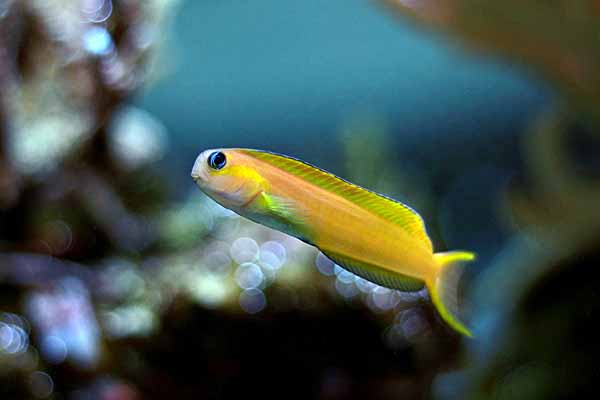
A unique feature of this species is its ecological mimicry of anthias (genus Pseudanthias). Field observations document Midas blennies schooling with anthias and resembling their coloration and swimming behavior. The cited observations do not establish the function or survival benefit of that resemblance. The presence of anthias in an aquarium also does not guarantee a particular color or temperament in the blenny.
Color Variation and What It Means
Midas blennies are best known for their golden coloration, often with blue accents around the eyes and fins, but individual appearance can vary.
Field observations document context-dependent color change, especially when Midas blennies associate with other schooling planktivores. Color alone cannot identify the cause of a change and is not a reliable health or stress diagnosis. Pair color observations with:
- Behavior (activity level, swimming pattern, use of shelter)
- Respiration rate (rapid or labored breathing)
- Appetite and feeding response
- Body condition (weight loss, gauntness)
- Physical signs (lesions, fin damage)
- Measured water trends (ammonia, nitrite, temperature, salinity)
Do not treat color shifts as a diagnosis in isolation. If you observe a dramatic or persistent change, investigate for other signs of distress and check system stability.
Tank Design: Swimming Space, Rock Refuge, Current, and Lid Security
Translating the Midas blenny’s natural history into aquarium design means focusing on both open swimming space and abundant rock refuge. This species spends much of its time swimming above the reef but depends on holes and crevices for shelter and security.
- Swimming Space: Prioritize horizontal open water for active swimming. Avoid tanks that are tall but narrow or crowded with rock to the point of limiting movement.
- Rock Refuge: Provide extensive live rock with multiple holes, caves, and crevices. This allows the blenny to retreat quickly if startled and reduces stress.
- Current and Oxygenation: Moderate water movement is beneficial, mimicking the natural reef slope environment. Ensure good surface agitation and oxygenation, especially in covered tanks.
- Lid Security: A tight-fitting lid is prudent aquarium risk management. Cover openings around cables, plumbing, and filter intakes with mesh or custom-cut material, and inspect regularly for gaps. This is conservative husbandry guidance rather than a measured species-specific jumping rate.
- System Stability: Use a mature, cycled filtration system. Monitor temperature, salinity, pH, ammonia, and nitrite for stability and trend, not just absolute values. Avoid rapid changes.

No specific gallon number guarantees success, but a 30-gallon (114 L) or larger tank with these features is a conservative starting point. The key is usable space, mature filtration, and secure refuge—not just volume.
Choosing a Specimen, Acclimation, and Quarantine
Careful selection and quarantine are critical for long-term success:
- Pre-purchase selection: Choose a specimen that is alert, swimming actively, with normal respiration, full body condition, intact fins and skin, and a demonstrated feeding response. Avoid fish that are listless, breathing rapidly, hiding constantly, or showing visible lesions.
- Acclimation: Match your acclimation process to the seller’s water parameters and methods. Dim lighting and minimize sudden changes during introduction. Keep the lid secured throughout acclimation.
- Quarantine: Use a dedicated, cycled quarantine tank with separate equipment. A minimum 30-day quarantine is recommended, monitoring for feeding, behavior, and signs of disease or stress (Merck Veterinary Manual; UF/IFAS). Do not introduce to the display tank until the fish is eating well and shows no signs of illness.
- Intervention: If you observe sustained rapid breathing, refusal to eat, weight loss, visible lesions, repeated bullying, or injury, seek qualified aquatic veterinary or experienced hobbyist help promptly.
Feeding a Water-Column Zooplanktivore: Tactics and Monitoring
Unlike many blennies that graze on algae, the Midas blenny is a zooplanktivore/planktivore, feeding primarily on planktonic animals in the water column. In captivity, success depends on providing:
- Varied, appropriately sized marine foods: Offer frozen or live foods such as mysis shrimp, enriched brine shrimp, finely chopped seafood, and high-quality marine pellets or flakes designed for carnivores/omnivores. Occasional inclusion of marine-origin algae is acceptable, but not required as a staple.
- Feeding distribution tactics: Feed in a way that allows the blenny to eat in the water column—broadcast feeding, target feeding near its refuge, or feeding away from aggressive tankmates. Multiple small feedings per day can help reduce competition and mimic natural foraging.
- Monitoring signals: Watch for active feeding response, stable or improving body condition, and minimal food waste. If the blenny is excluded from food by faster or more aggressive fish, adjust tactics or feeding location. Excess waste indicates overfeeding or poor distribution.
- Adjust as needed: Feeding frequency and portion size are practical heuristics—observe your fish and tank, and adapt as needed. There is no single “correct” schedule for all tanks.

Useful feeding signals include an eager response, active swimming, and stable body condition. Warning signs include weight loss, lethargy, or refusal to eat—review feeding access and tank dynamics if these occur. A color change by itself is not a feeding diagnosis.
Temperament, Tankmates, and Compatibility Stop Conditions
The Midas blenny is generally peaceful but can become territorial or aggressive toward similar-shaped fishes, other blennies, or competitors for holes and feeding space. Compatibility is context-dependent and changes with tank size, aquascape, and stocking.
- Elevated risk: Conspecifics, other blennies, and any fish that repeatedly competes with the Midas blenny for the same refuge or feeding access. Similar body shape or shelter use can be a warning sign, not a guaranteed outcome.
- Potentially lower resource overlap: Dissimilar-shaped fishes that use different shelter and feeding space may reduce direct competition, but no tankmate category guarantees compatibility.
- Observation plan: Monitor for repeated chasing, exclusion from food or shelter, visible injury, or sustained hiding. These are stop conditions—if observed, be prepared to intervene.
- Separation plan: Always have a feasible extraction route (net, trap, or temporary divider) in case separation is needed. Changing sight lines may be attempted as a management step, but it is not a proven cure; persistent exclusion or injury requires separation.
Do not rely on “peaceful” or “reef-safe” labels as guarantees. Compatibility must be observed and managed in your specific setup.
Lid Security as Conservative Risk Management
A secure lid is a prudent safeguard for an active aquarium fish, but the supplied sources do not quantify a Midas blenny jumping rate or establish a list of triggers. Treat lid security as conservative risk management rather than a claim about a measured “leading cause” of loss.
- Prevention: Cover all tank openings with a secure, escape-proof lid or mesh. Check for gaps around cables, filter intakes, and feeding ports. Inspect regularly for wear or displacement.
- Operational tips: Keep the lid secured during acclimation, maintenance, feeding, and after stocking changes. Recheck every opening before leaving the aquarium unattended.
- Incident response: Keep a net and temporary holding container accessible, and seek experienced or aquatic-veterinary guidance if a fish is injured.
Aquascaping: Balancing Swimming Space and Refuge
Design your aquascape to balance open horizontal swimming areas with ample rock refuge. Too much rock can crowd out swimming space; too little leaves the blenny exposed and stressed.
- Layout: Arrange rockwork to create multiple caves and crevices of varying sizes, with clear sightlines and access to open water. Both vertical and horizontal structures help support natural behaviors.
- Monitoring: Observe how your blenny uses the space—if it spends all its time hiding or seems reluctant to swim, adjust the aquascape to improve access to both shelter and open water.

Adult Size, Growth, and Implications for Tank Design
The best-supported evidence places the maximum size of Ecsenius midas at about 13 cm (5.1 in) total length (FishBase). Plan the tank and aquascape for a full-grown specimen, not a juvenile. As the fish grows, reassess swimming space, refuge access, feeding competition, and compatibility rather than assuming the juvenile setup will remain suitable.
Reproduction and Sourcing Context
FishBase describes distinct pairing, adhesive demersal eggs, and planktonic larvae for this species (FishBase). The supplied sources do not quantify current captive-bred availability or the present wild-caught share of the aquarium trade. Ask the seller about the exact animal’s provenance and favor traceable sourcing rather than assuming how it was produced or collected.
The supplied sources do not provide a home-aquarium breeding protocol. Do not infer an easy breeding recipe from these life-history facts; consult specialist, species-specific material before attempting it.
Is the Midas Blenny Right for Your Tank? Hard-Gate Checklist
- Can you provide a secure, escape-proof lid with no gaps?
- Does your tank offer ample horizontal swimming space and open water?
- Is your system mature, stable, and well-filtered?
- Do you have abundant rockwork with multiple holes and crevices for refuge?
- Can you monitor and intervene for aggression, feeding exclusion, or injury?
- Do you have a feasible extraction or separation plan if needed?
- Are you prepared to quarantine new arrivals for at least 30 days?
- Can you deliver varied, water-column foods and monitor feeding response and body condition?
If you cannot confidently answer “yes” to every item above, reconsider purchasing a Midas blenny. Meeting these requirements is essential for the health and longevity of this species in captivity.
References
- WoRMS: Ecsenius midas taxonomy — species identity and classification
- FishBase: Ecsenius midas summary — size, habitat, diet, reproduction, distribution
- FishBase: Ecsenius midas reproduction — pairing, egg type, larval stage
- Smithsonian blenniid mimicry account — historical observations and distributional context
- Anthias mimicry study — schooling and mimicry behavior
- Fishes of Australia: Ecsenius genus — genus-level context
- Merck Veterinary Manual: Aquarium fish management — quarantine and system management
- UF/IFAS: Responsible aquarium practices — quarantine, acclimation, filtration
- Michael, Scott W. Marine Fishes: 500+ Essential-to-Know Aquarium Species. T.F.H. Publications. 2001.
- Fenner, Robert M. The Conscientious Marine Aquarist. T.F.H. Publications. 2001.
- Wittenrich, Matthew L. The Complete Illustrated Breeder’s Guide to Marine Aquarium Fishes. T.F.H. Publications. 2007.
- Ulrich III, Albert B. The New Saltwater Aquarium Guide. 2007.
Beautiful fish! Too bad we haven’t found the secret to captive raising them. Back in 2013, I had partial success with Midas Blennies. Multiple attempts at raising the larvae with s-type rotifers proved unsuccessful. The larvae would die in batches up to the 8th day post hatch, when only a few were left. Not 1 would reach settlement/metamorphosis. The pair died about 1 year after the spawning events. My incomplete journal is still on the MBI with pictures on photo bucket site. Till this day, no new reports, not even what I was able to accomplish.
Hi Richard, thanks for the comment. So grateful to hear your experiences trying to raise them in captivity. Here’s a link to your breeding journal, for everyone to see (and thank you for publishing that, by the way). Appreciate all you have already done for breeding. I used to read your (and Kathy’s) posts all the time. Would be great to see someone pick up where you left off and breakthrough!