
The Three-stripe Damselfish (Dascyllus aruanus) earns its reputation for toughness. It generally adapts well to prepared foods and often tolerates the ordinary water-quality mistakes that challenge more delicate reef fish. But that is only half of the stocking question.
The harder lesson is behavioral. This is a small fish with a strong attachment to defensible shelter, and the territory it values is very important and doing several jobs at once: refuge, feeding position, breeding site (even though they are unlikely to breed in your tank), and social real estate. In a reef aquarium, all of that importance gets compressed and can cause stress, aggression, fighting, and even death in a home aquarium.
The Three-stripe Damselfish is a perfect example of a fish that looks easy on a care for on paper, but will most likely become a difficult long-term community resident.
How to recognize a Three-stripe Damselfish
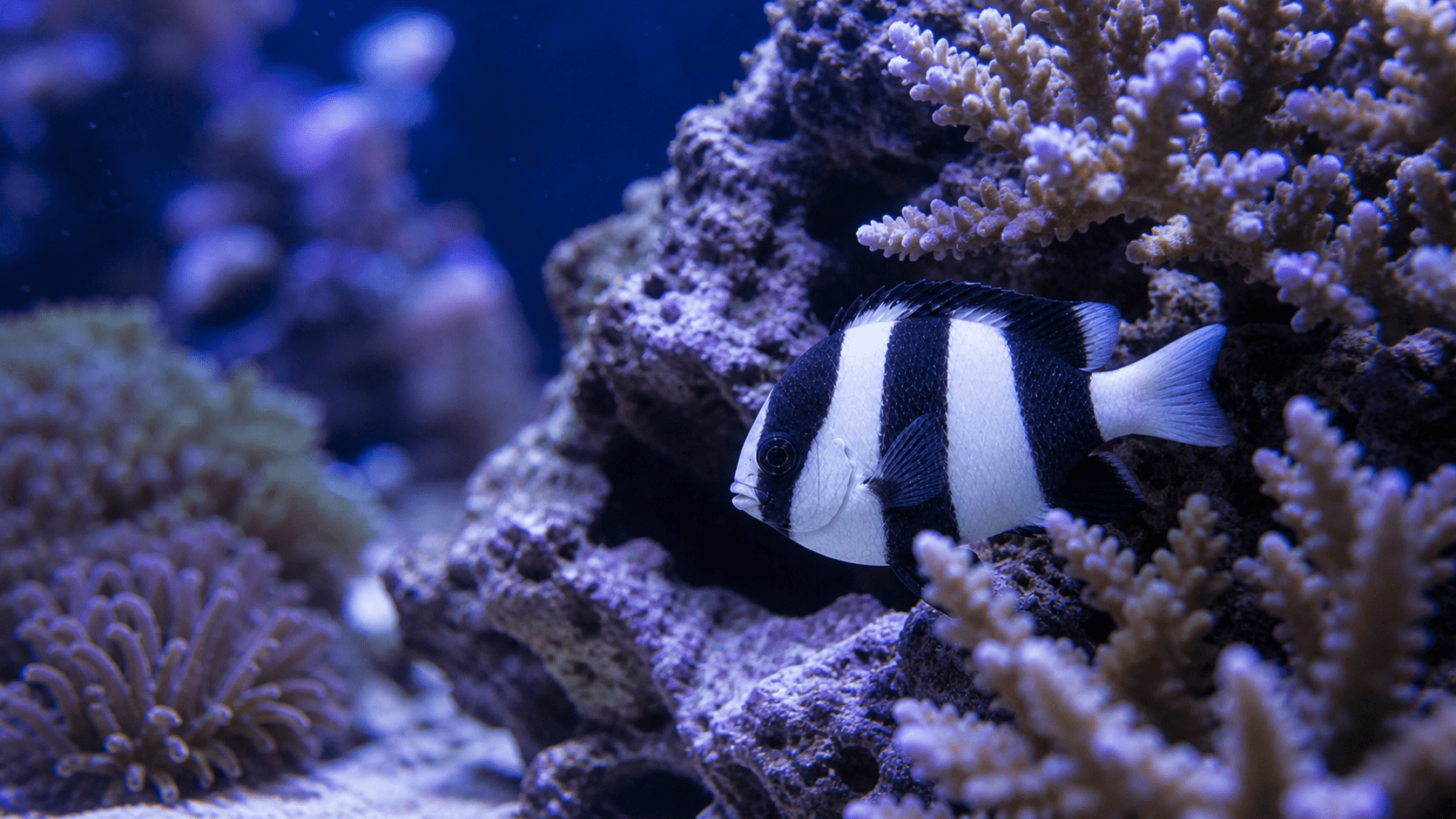
This fish has a deep, laterally compressed body with a distinctly rounded profile, a bright white background, three broad black vertical bars, a white caudal region, and black pelvic fins. In an aquarium it often holds an upright posture near cover, then retreats rapidly into coral or rockwork when startled.
Other Dascyllus species can sometimes be mis-identified or mislabeled, so it’s best to double-count those stripes yourself.

Species Snapshot
- Common name
- Three-stripe Damselfish
- Scientific name
- Dascyllus aruanus
- Family
- Pomacentridae
- Maximum reported length
- Approximately 10 cm (4 in) total length
- Native range
- Tropical Indo-Pacific
- Typical habitat
- Shallow reef flats, lagoons, patch reefs, and upper reef slopes with branching-coral shelter
- Feeding ecology
- Opportunistic omnivorous planktivore
- Physiological hardiness
- Hardy
- Behavioral difficulty
- Moderately to highly challenging
- Main watchout
- Territorial pressure can intensify as shelter becomes established and subordinate fish have difficulty escaping
- Minimum aquarium size
- There is no precise # that everyone agrees on, but my (Albert Ulrich) personal opinion is that 10 gallons is sufficient, if you’re keeping this fish solo.
- Conservation status
- Least Concern
Natural environment provides a window to view behavior
In the wild, Three-stripe Damselfish are closely associated with shallow, structurally complex branching corals. That structure is not background scenery. It provides protection from predators, a place to hover and feed, a site that can be defended, and—in breeding contexts—a nesting territory.
A fish that repeatedly uses one compact, valuable structure has a reason to defend it. Adults become more territorial as defensible shelter becomes more valuable, and breeding raises the value of that same location again. Aggression is therefore better understood as normal territorial behavior expressed in a limited environment, not as an unrelated personality flaw.
The “defend my territory” behavior is hard-wired into the fish… it’s not really fair to think of the aggression as bad thing. It’s a life skill that serves them well in the open reef, but causes problems in the confines of a saltwater tank like the one in your house (or the one you’re planning for)
In an aquarium, territory is compressed
The confines of the home aquarium can exacerbate (big word, are you impressed?) the territorial behavior. Natural reef fish can spread out or withdraw from a conflict; tankmates often cannot. When one compact area of rockwork or branching structure supplies the best refuge and feeding position, the fish that claims it may repeatedly pressure a slower, shyer, or more shelter-dependent neighbor.

You might be thinking… “so is the solution to add more aquascaping?”…my reply (I’m really talking to myself, this is bad), is to say…I wish it was that easy.
Additional tank volume and aquascaping does provide the potential for other fish to establish territories but it is not a complete recipe for success.
Choose tankmates by behavior, not just ‘hardy’
Fish that are confident, fast to feed, capable of defending personal space, and resilient during territorial interactions are generally better positioned to coexist than fish that are timid, slow to feed, easily displaced, chronically subordinate, or heavily dependent on the same limited shelter.
That is not a species-by-species guarantee. It is a way to see the conflict before it happens. A community built around passive fish, future timid additions, limited shelter, or overlapping territories deserves a pause before this damselfish is added. The same pause applies when the stocking order cannot be controlled: a resident territorial fish has a meaningful advantage over a newcomer.
Not sure if you’ve had experience with freshwater fish, but I sometimes lazily think of damselfish like saltwater cichlids. A lot of the advice in keeping cichlids in a community tank apply to this damsel (not in distress).
Aquascape and stocking order are part of compatibility
For this species, husbandry is not only about water chemistry. Multiple shelter options, broken sight lines, usable swimming space, and routes for a subordinate fish to avoid a dominant one all matter because they change the social terrain.
This is also why a juvenile’s early behavior should not be treated as a permanent forecast. Territoriality commonly develops as fish mature and establish ownership of shelter. A peaceful-looking small fish can be a poor fit later if the planned community depends on calm access to the same hiding places.
Feeding a fast, opportunistic planktivore
The Three-stripe Damselfish feeds readily because its natural ecology already favors rapid feeding in the water column. Its wild diet includes zooplankton, small benthic invertebrates, and algae, so a varied captive approach makes more sense than relying on one food alone.
Offer varied particle sizes, suspended foods, quality prepared foods, and occasional algae-containing foods. The point is not to build an elaborate menu for its own sake; it is to reflect an omnivorous planktivore that is adapted to take food quickly from the water column.
Why attempting to woo a mate can intensify aggression
Males establish nesting territories, court females, guard eggs, and defend the nest until hatching. That does not make reproductive aggression a separate mystery. It raises the stakes of an already defended site. If a mature fish starts planning for the future you should expect territorial aggression to get even more aggressive. Okay, planning for the future is just a tiny bit of anthropomorphism…deliberately departing from a purely scientific take to illustrate the point.
Pause before buying these adorable, inexpensive fish
Damselfish like the three-stripe and others are some of the most commonly purchased saltwater fish. They can seem almost irresistible in the store. But I recommend pausing before adding them, unless you are set on keeping an aggressive fish tank.